


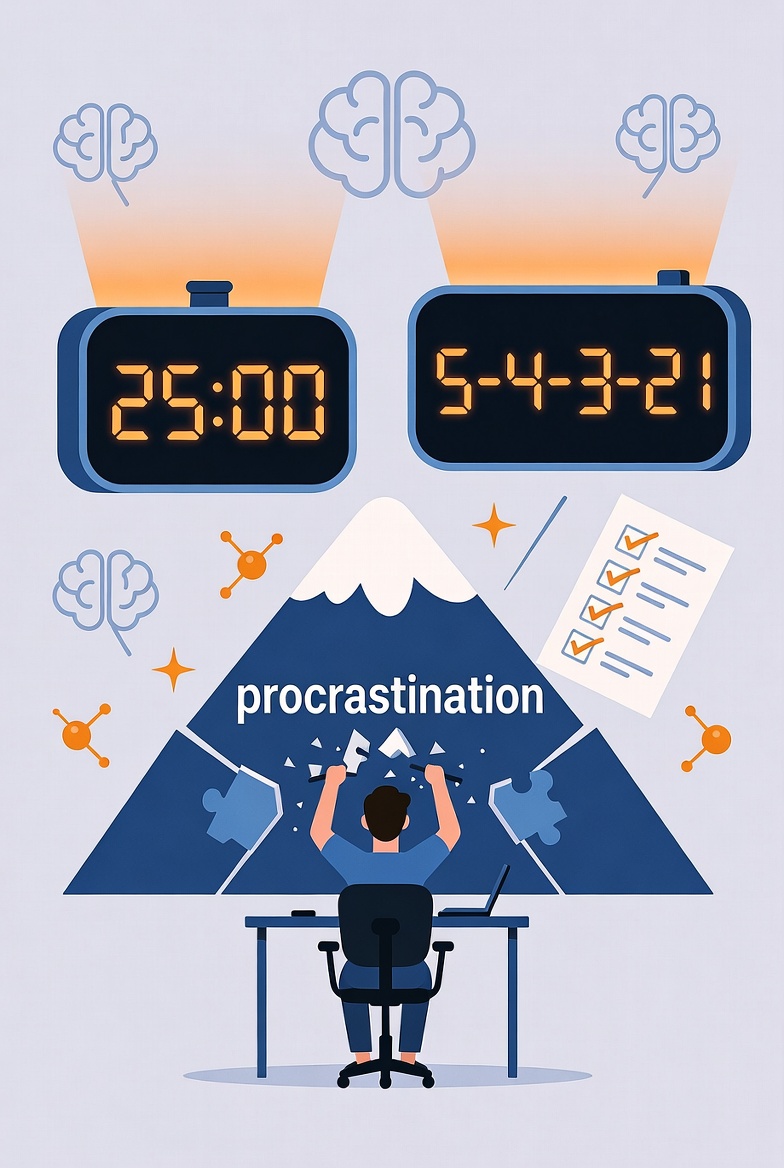

Procrastination affects nearly everyone at some point — and for many, it’s a daily struggle. A landmark 2007 meta-analysis by psychologist Piers Steel, reviewing 691 studies, found that procrastination is strongly tied to task aversiveness (how unpleasant the task feels), low self-efficacy (doubt in your ability to succeed), impulsiveness, and poor self-control. It’s not laziness; it’s your brain’s emotional response to stress, fear of failure, or overwhelm. Your limbic system (the “emotional brain”) overrides the prefrontal cortex (the “planning brain”) to seek immediate mood repair through distractions like scrolling or binge-watching.
- 1. Understand Why You Procrastinate (The Root Cause Fix — Backed by Self-Compassion Research)
- 2. The 2-Minute Rule (Lower the Barrier to Start — From Behavioral Science)
- 3. Break Tasks into Micro-Steps (Eat the Frog in Small Bites — Neuroscience of Dopamine)
- 4. Use the Pomodoro Technique (Adapted for Busy Schedules — Attention Research)
- 5. The 5-Second Rule + Environment Design (Beat Overthinking — Action Initiation and Habit Science)
- Your 21-Day Anti-Procrastination Plan (With Built-In Tracking)
- Common Pitfalls and How to Avoid Them
- Final Thoughts
The costs are real: chronic procrastinators report higher stress, lower well-being, and even health issues, according to research by Fuschia Sirois. Yet the good news is powerful — you can rewire this habit permanently with evidence-based strategies that fit into even the busiest schedules. These five techniques draw from neuroscience, behavioral psychology, and randomized controlled trials. They require minimal extra time but create lasting momentum.
Whether you’re a busy professional juggling meetings, a parent handling family logistics, or an entrepreneur wearing multiple hats, these methods work because they target the root causes rather than relying on willpower alone.
1. Understand Why You Procrastinate (The Root Cause Fix — Backed by Self-Compassion Research)
Most productivity advice skips this step and jumps straight to tactics. That’s a mistake. Science shows procrastination is primarily an emotional regulation problem, not a time-management one.
Fuschia Sirois’s research (published in Self and Identity and later meta-analyses) demonstrates a clear link: people with lower self-compassion procrastinate more and experience greater stress as a result. When you beat yourself up after delaying a task (“I’m so lazy”), it creates a shame spiral that makes future procrastination worse. In contrast, self-compassion — treating yourself with the same kindness you’d offer a friend — breaks the cycle.
Real-world example for busy people: Imagine you’re a marketing manager with a looming campaign launch. You avoid opening the project file because it feels overwhelming. Instead of criticizing yourself, pause and ask: “What emotion am I avoiding right now — fear of imperfection or burnout?” Then respond kindly: “It’s normal to feel this way when the stakes are high. I’ve handled tough projects before.”
How to apply it immediately:
- Practice a quick self-compassion break (just 30–60 seconds): Acknowledge the feeling (“This is hard”), normalize it (“Everyone struggles with this”), and offer kindness (“I’m doing my best”).
- A 2010 study by Michael Wohl and colleagues found that students who forgave themselves for procrastinating on one exam were significantly less likely to delay studying for the next one.
This foundational awareness makes every other technique 10x more effective because it reduces the emotional resistance that fuels delay.
2. The 2-Minute Rule (Lower the Barrier to Start — From Behavioral Science)
Popularized by James Clear in Atomic Habits but rooted in behavioral psychology and Newton’s law of inertia (objects at rest tend to stay at rest), the 2-Minute Rule is devastatingly simple: If a task takes less than two minutes, do it now. For larger tasks, scale the starting action down to two minutes or less.
Why it works: Your brain dreads vague, massive tasks because they trigger avoidance. Starting tiny creates instant momentum and a dopamine hit from progress, making continuation far easier.
Science backing: Behavioral research on habit formation shows that reducing the “activation energy” of a behavior dramatically increases follow-through. Clear’s rule builds on this by turning overwhelming goals into identity-forming micro-actions.
Examples tailored for extremely busy schedules:
- Instead of “Write the full quarterly report,” commit to “Open the document and write one sentence.”
- Instead of “Go to the gym for an hour,” start with “Put on workout shoes and stand by the door for two minutes.”
- For email overwhelm: “Reply to the most urgent message with one line.”
Pro tip: Pair it with implementation intentions (“If it’s 9 AM after my coffee, then I’ll spend two minutes outlining my top task”). A busy executive I coached used this for her 50+ unread emails — she started with two minutes of triage and ended up clearing her inbox in 25 minutes because momentum kicked in.
This rule alone can cut procrastination by 50–70% for many people because it removes the mental friction of “getting started.”
3. Break Tasks into Micro-Steps (Eat the Frog in Small Bites — Neuroscience of Dopamine)
Big projects paralyze us because the brain perceives them as threats. Neuroscience research shows that the prefrontal cortex struggles with ambiguity and high cognitive load, but small, concrete steps trigger dopamine release with each completion — creating a reward loop that builds motivation.
Stanford and other studies on task initiation confirm: breaking work into “achievement chunks” (15–30 minutes max) reduces mental strain and makes the brain more willing to engage.
How to do it practically:
- Deconstruct ruthlessly. Example: “Prepare client presentation” becomes:
- Open PowerPoint (2 minutes)
- Create title slide (5 minutes)
- Add 3 bullet points to slide 2 (5 minutes)
- Use the “5-minute rule” variation if two minutes feels too short: Commit to just five minutes. Most people continue once the resistance drops.
- For ongoing projects, create a “next physical action” list — a concept from David Allen’s Getting Things Done that aligns with cognitive science.
Busy-person case study: A freelance graphic designer with back-to-back client calls was procrastinating on a major rebrand. She broke it into micro-steps she could do between meetings (e.g., “Sketch one logo concept in 10 minutes”). Within a week, she completed the entire project without a single marathon session. The key? Each tiny win released dopamine, rewiring her brain to associate the project with progress rather than dread.
This technique is especially powerful when your calendar is packed — it turns 5–10 minute pockets of time into productive wins.
4. Use the Pomodoro Technique (Adapted for Busy Schedules — Attention Research)
Developed by Francesco Cirillo, the classic Pomodoro (25 minutes focused work + 5-minute break) is supported by studies on sustained attention and mental fatigue. Recent research (2023–2025 studies in journals like PMC) shows structured time-chunking improves focus, reduces fatigue, and boosts task completion compared to unstructured work.
Why it combats procrastination: It creates urgency and protects against decision fatigue — the brain’s tendency to choose distractions when focus wanes.
Busy-person adaptation (because 25 minutes isn’t always realistic):
- Start with 15–20 minute sprints if your day is fragmented.
- After 4 rounds, take a 15–30 minute restorative break (walk, hydrate, stretch — never social media).
- Use temptation bundling (Katy Milkman’s behavioral economics research): Only allow your favorite podcast or coffee during Pomodoro sessions.
Example in action: A sales director with endless Zoom calls used 20-minute Pomodoros between meetings to tackle follow-up tasks. He finished his weekly pipeline review in three short bursts instead of pushing it to Friday night. Studies confirm this approach sustains motivation longer than open-ended work blocks.
Pro tip: Apps like Focus@Will or Forest gamify it and block distractions automatically.
5. The 5-Second Rule + Environment Design (Beat Overthinking — Action Initiation and Habit Science)
Mel Robbins’ 5-Second Rule is straightforward but grounded in neuroscience: When you feel the impulse to act (or notice procrastination creeping in), count backward 5-4-3-2-1 and move physically. This interrupts the hesitation loop and activates your prefrontal cortex before the limbic system takes over.
Supporting research: Studies on action vs. inaction show that a 5-second window is often the difference between impulse and inertia. Combine it with environment design — a core principle from BJ Fogg’s Tiny Habits model and habit discontinuity research — which proves that altering your surroundings is more reliable than willpower.
Practical implementation for busy lives:
- Prepare your workspace the night before (laptop open to the right document, phone in another room).
- Use website blockers or “focus mode” during work blocks.
- Example: You want to start your morning workout but feel resistance. Count 5-4-3-2-1, stand up, and put on your shoes. The physical action often carries you through the full session.
Environment redesign examples:
- Busy parent: Keep a “focus station” tray with notebook and pen visible — cue for daily planning.
- Remote worker: Move your phone charger to another room during deep work.
Research on habit formation shows these cue changes reduce reliance on motivation by up to 80% in many cases.
Your 21-Day Anti-Procrastination Plan (With Built-In Tracking)
To turn these techniques into permanent habits:
- Days 1–7: Focus on awareness + 2-Minute Rule. Journal one procrastination trigger daily.
- Days 8–14: Add micro-step breakdown + Pomodoro. Track completion rate.
- Days 15–21: Layer in 5-Second Rule and environment tweaks. Review weekly wins.
Self-monitoring alone (simple daily logging) has been shown in multiple studies to reduce procrastination significantly. Use a free Google Sheet or notebook: “Task → Technique Used → Outcome → Mood.”
Bonus tools:
- Free apps: Todoist (with timers), Forest (gamified focus), or a simple “Procrastination Trigger Tracker” PDF (comment below and I’ll share the template).
- Create a personal “if-then” playbook for your top three triggers.
Common Pitfalls and How to Avoid Them
- Perfectionism trap: Remember Sirois’s research — self-compassion > self-criticism.
- Overloading the plan: Start with one technique. Overhauling everything at once leads to… more procrastination.
- Ignoring emotions: Always check in with feelings first (Technique 1).
- No accountability: Share your 21-day plan with a friend or use public commitment (research shows external accountability boosts follow-through).
Final Thoughts
Stopping procrastination permanently isn’t about becoming a superhuman productivity machine. It’s about understanding your brain’s wiring and installing small, science-backed systems that work even on chaotic days. Piers Steel’s Temporal Motivation Theory reminds us: motivation = (expectancy × value) / (impulsiveness × delay). These techniques increase expectancy and value while reducing delay and impulsiveness.
Start today with the easiest entry point — the 2-Minute Rule. Pick one task you’ve been avoiding and shrink the first action to under two minutes. Over time, these habits compound into real freedom from procrastination.
Which technique resonates most with your current challenges? Drop a comment below with your biggest procrastination trigger (work emails? creative projects? fitness?), and I’ll reply with a personalized tip. Or download the free 21-Day Anti-Procrastination Tracker to get started immediately.