


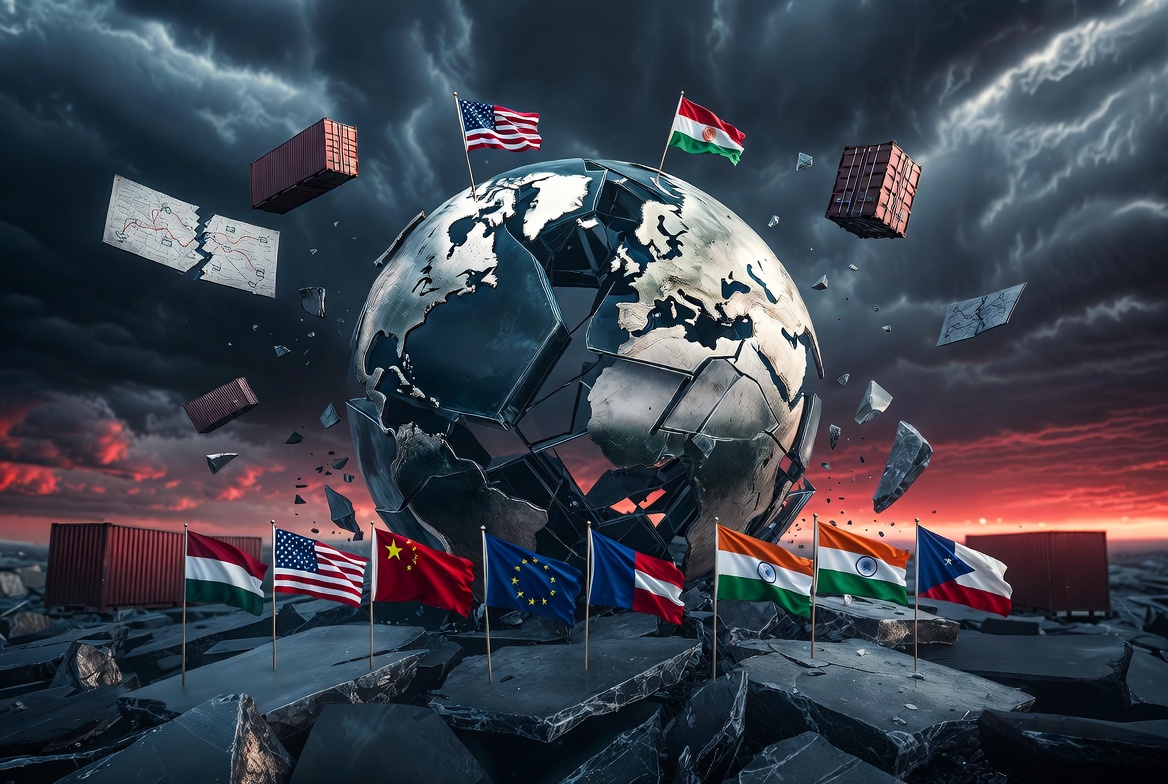

Ten years ago, the dominant narrative in economics and geopolitics was clear: globalization was unstoppable. Supply chains stretched across continents, capital flowed freely, and the world seemed to be moving toward ever-greater economic integration. Multinational corporations optimized for efficiency, consumers enjoyed lower prices, and emerging markets lifted hundreds of millions out of poverty. The liberal international order, built after World War II and accelerated after the Cold War, appeared triumphant.
In 2026, that narrative feels like ancient history.
What we are witnessing is not the complete collapse of globalization, but its profound transformation into something new: a fragmented, security-first, regionally oriented system increasingly defined by economic nationalism. Governments are no longer willing to accept maximum efficiency if it comes at the cost of national resilience, technological sovereignty, or strategic autonomy. The result is a world where trade still exists, but it is channeled through “friend-shoring,” “near-shoring,” and deliberate decoupling from perceived adversaries.
This shift did not happen overnight. It is the cumulative result of multiple shocks — the 2008 financial crisis, the COVID-19 pandemic, the Russia-Ukraine war, supply chain breakdowns, rising great-power competition, and, most recently, the direct military confrontation involving Iran. Each event exposed the vulnerabilities of hyper-globalization and strengthened the political case for economic self-reliance.
The Golden Age and Its Cracks
From the early 1990s until roughly 2015, globalization delivered impressive results. Global trade as a share of GDP rose from about 40% in 1990 to nearly 60% by 2008. Foreign direct investment (FDI) exploded. China’s accession to the WTO in 2001 became the single largest driver of global growth in modern history. Consumers in developed economies enjoyed cheap goods, while developing nations gained access to capital, technology, and markets.
But the system contained hidden fragilities. Over-reliance on single suppliers (especially China for manufacturing and critical minerals), just-in-time inventory models with almost no redundancy, and the financialization of global supply chains created extreme vulnerability to disruption. The 2008 financial crisis was the first warning. The COVID-19 pandemic in 2020–2022 delivered the second, exposing how dependent the world had become on a handful of choke points.
By 2023, the term “deglobalization” had entered mainstream discourse. What began as a slow re-evaluation accelerated dramatically after 2024. The war on Iran in early 2026 became the latest and perhaps most consequential catalyst. The partial closure of the Strait of Hormuz, massive spikes in energy prices, and renewed fears over maritime security forced companies and governments to confront a harsh reality: in a truly globalized world, distant conflicts can paralyze entire economies overnight.
2026: The New Architecture of Economic Nationalism
Today, economic nationalism manifests in several concrete ways:
1. Friend-Shoring and Regional Blocs Companies are actively moving production away from geopolitical risk zones toward “friendly” countries. The United States has heavily incentivized near-shoring to Mexico and reshoring to domestic soil through the CHIPS Act and Inflation Reduction Act. Europe is pursuing “strategic autonomy” with massive subsidies for semiconductors, batteries, and critical raw materials. India has used production-linked incentive schemes to attract electronics and pharmaceutical manufacturing. Even China is quietly encouraging “dual circulation” — strengthening domestic supply chains while maintaining selective international links.
2. Industrial Policy Is Back Governments that once preached free markets are now openly practicing industrial policy. The US, EU, Japan, South Korea, and India have all launched multi-hundred-billion-dollar programs to secure semiconductors, rare earths, electric vehicle batteries, and green technologies. Subsidies, tariffs, local content requirements, and export controls have become standard tools.
3. Weaponization of Economic Tools Trade is no longer just commerce — it is strategy. Export controls on advanced AI chips, investment screening mechanisms, carbon border adjustment taxes, and secondary sanctions have become routine. The line between economic policy and national security has effectively disappeared.
4. Supply Chain Resilience Over Efficiency The old mantra of “just-in-time” has been replaced by “just-in-case.” Companies are accepting higher costs for redundancy, dual sourcing, and stockpiling. This shift is structurally inflationary but politically popular because it reduces vulnerability.
Winners and Losers in the New Era
This transformation creates clear winners and losers.
Winners:
- Countries with strong domestic markets, technological capabilities, and political stability (United States, India, some ASEAN nations).
- Sectors related to defense, energy security, critical minerals, and advanced manufacturing.
- Nations that successfully attract “friend-shored” investment (Mexico, Vietnam, Poland, Morocco).
Losers:
- Small open economies heavily dependent on global trade without strong regional anchors.
- Export-oriented manufacturers in China that lose access to Western markets.
- Consumers worldwide, who face structurally higher prices for goods ranging from electronics to automobiles and pharmaceuticals.
- Developing countries in Africa and parts of Latin America that risk being left out of new regional supply chains.
The Economic Cost of Fragmentation
Economists at the IMF, World Bank, and private institutions estimate that full deglobalization could reduce global GDP by 5–10% over the long term. Even partial fragmentation — the more likely scenario — is expected to shave 2–4% off global output by 2035 through reduced efficiency, higher costs, and slower innovation diffusion.
Yet many governments view this as an acceptable price for enhanced security. In an era of great-power competition, resilience is increasingly valued more than pure efficiency. National security has become the new comparative advantage.
Is This the End of Globalization?
Not exactly. What is ending is hyper-globalization — the extreme, efficiency-obsessed version that dominated from the 1990s to the early 2010s. What is emerging is a more cautious, selective, and politically managed form of international economic engagement.
Trade volumes are not collapsing; they are being redirected. Global FDI has not disappeared; it is being channeled toward allies and trusted partners. Supply chains are not vanishing; they are becoming shorter, more regional, and more diversified.
This new system is sometimes called “slowbalization,” “regionalization,” or “friend-shoring.” Whatever the label, its defining characteristic is that economic decisions are increasingly filtered through a national security and political lens rather than pure market logic.
The Road Ahead
Looking toward 2030 and beyond, several scenarios are possible:
- Managed Fragmentation (most likely): The world splits into competing but still interconnected economic blocs (US-led, China-led, and a more independent European/Indian bloc). Trade continues, but within clearer political boundaries.
- Full Decoupling: Extreme scenario in which the US and China completely separate their economies. This would be enormously costly and is considered unlikely in the near term.
- Re-Globalization 2.0: A more optimistic outcome in which new rules, technologies (such as digital trade agreements and blockchain-based verification), and multilateral frameworks allow for safer, more resilient global integration.
The most probable path is messy, uneven, and regionally differentiated. Globalization is not dying — it is being renegotiated under new terms where sovereignty, security, and resilience carry greater weight than they did during the golden age of free trade.
For businesses, the message is clear: adaptability and geopolitical awareness are now core competencies. For governments, the challenge is to pursue legitimate national interests without triggering destructive protectionist spirals. For individuals, the world of work, consumption, and opportunity is becoming more complex and more politically charged.
The era of effortless globalization is over. The era of strategic, selective, and often tense economic engagement has begun.
In 2026, the question is no longer whether globalization will survive. The real question is: what kind of globalization do we want — and at what cost?