


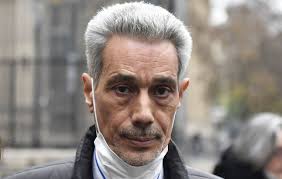

Omar Raddad, a Moroccan immigrant who became the focal point of one of the most high-profile and debated criminal cases in modern French history, has spent decades fighting to clear his name. Known simply as the “Omar Raddad Affair,” the saga revolves around the 1991 murder of wealthy French widow Ghislaine Marchal and the subsequent conviction of Raddad, her gardener, despite persistent questions about evidence, justice, and potential bias.
The Crime and the Infamous Message
In June 1991, 65-year-old Ghislaine Marchal, a socialite and heiress living in a luxurious villa in Mougins on the French Riviera, was found brutally stabbed to death in her basement. Beside her body, investigators discovered two chilling messages scrawled in her own blood on nearby doors: “Omar m’a tuer” (“Omar has kill me”) on one, and an incomplete “Omar m’a t” on another.
The name “Omar” immediately pointed to Omar Raddad, then 27, a Moroccan-born gardener who had worked for Marchal for several years. Raddad, who spoke limited French and was illiterate at the time, was arrested shortly after. He has consistently maintained his innocence, claiming he had no involvement in the crime.
The Trial and Conviction
In 1994, after a highly publicized trial, Raddad was convicted of murder and sentenced to 18 years in prison. The prosecution’s case relied heavily on the blood-written messages as a dying declaration from the victim, along with Raddad’s access to the property as her employee. There was no DNA evidence linking him to the crime scene at the time, no murder weapon recovered, and no clear motive beyond speculation.
Critics quickly highlighted glaring issues: the phrase “Omar m’a tuer” contains a grammatical error (“tuer” should be “tué” in correct French), raising doubts about whether an educated woman like Marchal would write it that way in her final moments. Many argued the message could have been fabricated or misinterpreted, and some pointed to possible anti-immigrant bias in the investigation and trial, given Raddad’s background as a North African outsider in a wealthy French setting.
Partial Pardon and Release
The case drew international attention, including intervention from Morocco’s King Hassan II, who appealed to French authorities on Raddad’s behalf. In 1996, French President Jacques Chirac granted a partial pardon, reducing the sentence significantly. Raddad was released conditionally in 1998 after serving about four years. However, the pardon did not equate to exoneration—he remained legally guilty under French law.
Ongoing Fight for Justice
Raddad’s battle continued long after his release. In the 2000s and beyond, advances in forensic science offered new hope. DNA testing on blood samples from the crime scene (authorized in later years) reportedly found no trace of Raddad’s DNA among several unidentified profiles, fueling arguments for a miscarriage of justice.
In 2021, a French court approved reopening the case after Raddad’s lawyers presented fresh evidence, including expert analyses of the DNA and handwriting elements. This decision marked a major victory in his decades-long effort to prove innocence and highlighted broader questions about wrongful convictions, racial prejudice in the justice system, and the reliability of dying declarations.
The affair has inspired books, documentaries, and even a 2011 French film titled Omar m’a tuer (starring Sami Bouajila as Raddad), which dramatizes his perspective and the flaws in the original investigation.
Legacy and Symbolism
Today, Omar Raddad’s name remains synonymous in France with debates over judicial errors, immigrant rights, and class/racial dynamics in the legal system. Supporters view him as a victim of prejudice and flawed evidence; others maintain the conviction was sound. As of recent years, the case continues to symbolize unresolved questions in one of Europe’s most enduring murder mysteries.
Whether full exoneration comes remains uncertain, but the Omar Raddad Affair endures as a powerful reminder of how one message in blood can alter a life—and spark national soul-searching—for generations.
 WORLDNABD
Global Geopolitical Analysis Platform
 The World’s Pulse
 www.worldnabd.com